Varroa Management
Inside the Capped Cell: The Varroa Reproductive Cycle Explained
Varroa mites don't reproduce in the open — they hide inside capped brood cells for 10 days, invisible to contact treatments. Understanding this cycle explains every management decision.
title: "Inside the Capped Cell: The Varroa Reproductive Cycle Explained" category: "Varroa Management" summary: "Varroa mites don't reproduce in the open — they hide inside capped brood cells for 10 days, invisible to contact treatments. Understanding this cycle explains every management decision." readTime: 7 difficulty: "beginner" season: "year-round" slug: "varroa-reproductive-cycle" publishedAt: "2026-03-03" course: "beginner" module: "Varroa Management" lessonOrder: 9
Most beekeeping problems are visible — you can see a failing queen, spotty brood, or low stores. Varroa is different. The part of the life cycle that matters most happens inside sealed cells, out of sight, for roughly 10 days per generation. Understanding what's happening in there explains why timing matters so much in Varroa management.
The Five-Stage Cycle
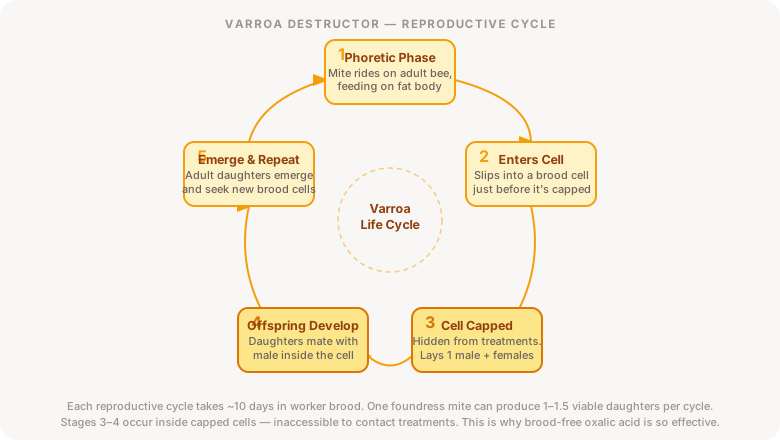
Stage 1: Phoretic Phase (On the Adult Bee)
A non-reproducing "phoretic" mite rides on the body of an adult bee between brood cycles. During this phase the mite feeds on the bee's fat body — the metabolic organ responsible for protein storage, immunity, and winter longevity. Even before it reproduces, a phoretic mite is doing damage.
The phoretic phase lasts anywhere from a few days to several weeks, depending on how much capped brood is available. In a colony with abundant brood (summer), mites cycle rapidly and the phoretic phase is short. In a colony with little or no brood (winter), all mites are phoretic — which is precisely why brood-free oxalic acid treatments work so well.
Stage 2: Entering the Brood Cell
The foundress mite (the reproducing female) waits in the hive's brood nest for a suitable cell approaching capping. She typically chooses a worker or drone larva on day 5–6 of larval development — just hours before it will be capped. She slides in and hides in the royal jelly under the larva.
Drone brood is preferred. Drone cells remain capped for approximately 24 days (vs. 12 days for worker cells), giving the mite more time to produce viable offspring. A single mite produces up to 2–3 viable daughters in drone brood, compared to 1–1.5 in worker brood. This is the biological basis for drone brood removal as a management tool — removing capped drone frames removes a disproportionate number of mites.
Stage 3: The Cell is Capped
Once the cell is capped, the mite is completely inaccessible to contact-based treatments like amitraz (Apivar) or thymol (Apiguard). She begins feeding on the developing pupa and waits until the larval feces appear — a chemical signal that triggers her egg-laying.
The foundress lays her first egg about 70 hours after capping. The first egg is always male. Subsequent eggs (laid every 30 hours) are female.
Stage 4: Offspring Develop and Mate
The male mite matures first and mates with his sisters as they develop inside the cell. The first female offspring to reach maturity will often produce her own offspring in the same cell if capping time allows — this is more common in drone brood, where the extended capping period enables a second reproductive cycle.
Not all eggs become viable adults. In a worker brood cell (capped ~12 days), typically one viable female daughter survives to emerge. The foundress and male mite die inside the cell.
Stage 5: Emergence and Repeat
When the bee emerges, the viable daughter mites leave with her and immediately enter the phoretic phase, seeking new brood cells to begin the cycle again. The foundress who entered the original cell may also survive to reproduce again if she's still viable.
One mite entering one cell produces one viable daughter. This sounds slow — until you account for exponential growth across an entire colony with thousands of brood cells cycling every 12 days.
Why This Cycle Determines Treatment Timing
The reproductive cycle explains every key principle of Varroa management:
Why alcohol wash counts measure phoretic mites. An alcohol wash samples mites on adult bees — the phoretic population. Mites inside capped cells aren't counted. This is a known limitation: your true total mite burden is always higher than your wash result, since a portion is always reproducing inside brood.
Why contact treatments (Apivar, Apiguard) require 6–8 weeks. These treatments only kill phoretic mites. Mites inside capped cells are shielded. A full brood cycle needs to turn over — with each new adult bee emerging and its mite becoming phoretic — before the treatment reaches maximum efficacy.
Why oxalic acid works best when there's no brood. Oxalic acid dribble or vapor kills phoretic mites on contact and has minimal penetration into capped cells. In a colony with no capped brood (mid-winter, or after an artificial brood break), all mites are phoretic and a single oxalic acid treatment can achieve 95%+ efficacy. The same treatment in a colony with full brood might only reach 60–70% efficacy.
Why the fall treatment window is critical. In late summer, colonies begin reducing brood rearing. As the brood population shrinks, the ratio of phoretic mites to total mites increases — mites that were cycling through brood cells are forced onto adult bees. If you treat at this moment (August in most of North America), you catch a high proportion of the total mite population in the phoretic, treatment-accessible phase, and the winter bees about to be raised are protected.
Why waiting to treat is dangerous. Varroa populations grow geometrically. The cycle time is fast — roughly 10 days per reproductive cycle. At a 2% infestation rate, a colony left untreated can reach 5–8% within 4–6 weeks as the summer bee population declines. By the time visible symptoms appear (deformed wings, dying pupae), the colony is often past the point of recovery.
Key Takeaways
- Varroa reproduces entirely inside capped brood cells. Contact treatments can't reach them there.
- One mite, one cell, one viable daughter — but this multiplies across thousands of cells and generations.
- Drone brood produces more mites per cycle (2–3 daughters vs. 1–1.5 in worker brood). Drone brood removal reduces mite growth rate.
- Oxalic acid is most effective brood-free because all mites are phoretic and accessible.
- Fall treatment timing matters because mite-to-bee ratios peak as brood rearing declines — and the bees being raised then must survive winter.
- Your alcohol wash only counts phoretic mites. The actual total load is always higher. Treat at 2% on the wash — don't wait for clinical signs.
Next in the Beginner Course
How to Monitor Varroa: Alcohol Wash, Sugar Roll, and Sticky Boards
Continue reading
Integrated Pest Management for Varroa: A Year-Round Strategy
IPM means using monitoring data to drive treatment decisions — not calendar dates. Here's how to build a Varroa management calendar that keeps mite loads below threshold year-round.
How to Monitor Varroa: Alcohol Wash, Sugar Roll, and Sticky Boards
Monitoring is the only way to know whether your Varroa load is at a safe level or approaching colony-threatening territory. Here's how to do an alcohol wash — the gold standard — and when each method is appropriate.
When Varroa Treatment Fails: Resistance, Reinfestation, and What to Do
You treated on schedule, but the mite count barely moved. Here's how to distinguish true treatment resistance from reinfestation, application error, and timing problems — and what to do about each.